


 YL2023-07-12 23:26:12
 YL
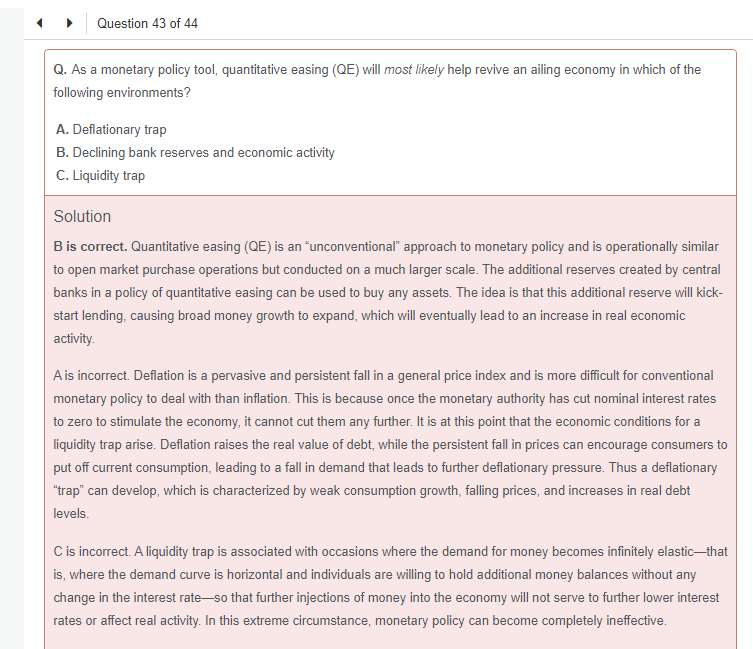
YLModule 5-官网习题-Question 43-1. 没有明白这道题为什么B是正确答案?B选项答案解释的最后一句话The idea is that this additional reserve will kick-start lending, causing broad money growth to expand, which will eventually lead to an increase in real economic activity.和B选项表述的含义是相反的,不是一致的?2. C选项,没有明白为什么错?
回答(1)
 Alex2023-07-13 13:37:37
 Alex
Alex你好同学
按理说量化宽松是解决流动性陷阱的有效途径之一。所以这道题可能出的不太好。亦或者是B选项更优。
假设没有C选项。应该是选B。因为题干里说的是量化宽松是用来解决下列哪些问题的。所以解释里会和B选项表述正好相反。量化宽松,政府大量从银行手里买金融证券,可以增加银行手里的“现金”,也就是银行准备金,继而促进经济。
可以参考原版书308页
The additional reserves created by central banks in a policy of quantitative easing
can be used to buy any assets. The Bank of England chose to buy gilts (bonds
issued by the UK government), where the focus was on gilts with three to five years
maturity. The idea was that this additional reserve would kick-start
lending, causing
broad money growth to expand, which would eventually lead to an increase in real
economic activity. But there is no guarantee that banks will respond in this way. In
a difficult economic climate, it may be better to hold
如果我的回答帮到了你,可以点击“采纳”哦
- 评论(0)
- 追问(2)
- 追问
-
C错在哪儿?C错误的依据,在书上第几页有明确写?liquidity trap 流动性陷阱 具体指什么?
- 追答
-
这道题出的不好,C选项应该也是正确选项。
307页有流动性陷阱的解释
In very extreme instances, there may be occasions where the demand for money
becomes infinitely elastic—that is, where the demand curve is horizontal and individuals
are willing to hold additional money balances without any change in the interest
rate—so that further injections of money into the economy will not serve to further
lower interest rates or affect real activity. This is known as a liquidity trap.



评论
0/1000
追答
0/1000
+上传图片