


 YL2023-07-12 21:49:52
 YL
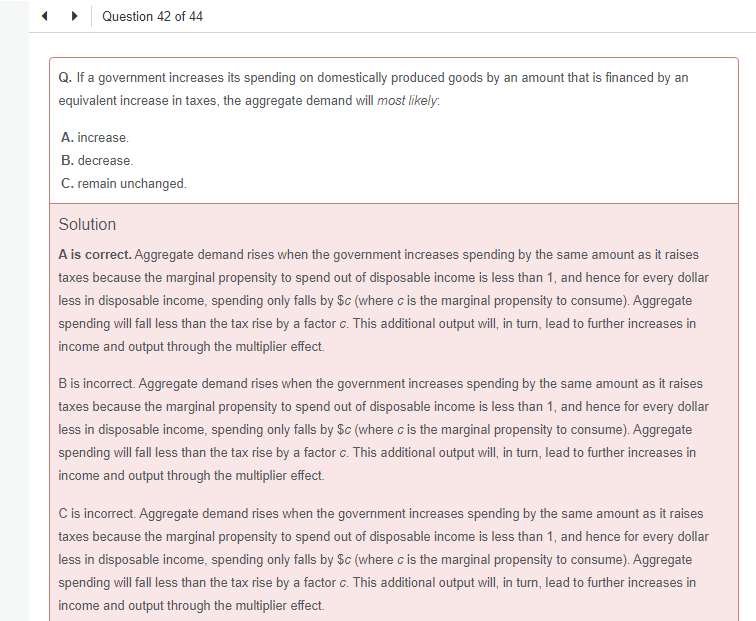
YLModule 5-官网习题-Question 42-A选项答案不明白,请解析。尤其是:为什么可支配收入中的边际消费倾向小于1?为什么“当可支配收入每减少1美元,必然伴随着支出减少c美元(其中c是边际消费倾向)”?为什么“总支出的下降幅度将小于增税幅度的一个系数c。这种额外的产出反过来又会通过乘数效应导致收入和产出的进一步增加。”?
回答(1)
最佳
 Alex2023-07-13 13:18:37
 Alex
Alex
We define s as the marginal propensity to save (MPS), the amount saved out of
an additional dollar of disposable income. Because c + s = 1
disposable income就两个用途,消费跟存款。消费的比例=消费/disposable income是恒小于一的,也被称为边际消费倾向小于1。
disposable incom减少1,那么消费就按比例减少了c*1.
Households spend a proportion c of disposable income, YD, that is, cYD or c(Y– NT) or c(1 – t)Y.
YD = Y – NT = (1 – t) Y
Y=G+C+I+X-M
C消费增加会导致Y增加,Y增加YD会增加(1-t)Y,有一部分被消费了也就是c(1-t)Y,消费增加又会导致Y增加,以此循环
- 评论(1)
- 追问(2)
- 追问
-
这句话怎么理解:总支出的下降幅度将小于增税幅度的一个系数c ?是依据哪个公式展开说的?
- 追答
-
可以参考原版书325页给出的例子
Suppose an economy has an equilibrium output or income level of $1,000 consisting
of $900 of consumption and $100 of investment spending, which is fixed and
not related to income. If government spending is set at $200, financed by a tax rate of
20 percent (giving tax revenue of $200), what will happen to output? First, additional
government spending of $200 will raise output by that amount; but will taxes of $200
reduce output by a similar amount? Not if the MPC is less than 1; suppose it is 0.9, and
hence spending will only fall by 90 percent of $200, or $180. The initial impact of the
balanced fiscal package on aggregate demand will be to raise it by $200–$180 = $20.
根据cYD.
根据题干,假设增加的政府支出与税都是x。因为税增加x,那么可支配收入减少x,消费减少cx. 又因为政府支出是x,所以总效应为x-cx



评论
0/1000
追答
0/1000
+上传图片